The ‘tough old boot’ – an overview of “Liberation of Italy”
The Italy Campaign has had a long relation with my local Flames of War community. From playing my first “big” game in v1; a refight of the capture of Primosole Bridge in Sicily, to running an “Infantry Aces” Cassino campaign in v3 to some excellent games on Mike’s Italy terrain in the barn in v4.
Throughout v4, LW Italy was in something of a limbo; kinda covered by “Fortress Europe” but never really detailed on the road map and seeming to be oft mentioned but never delivered in the end of year reviews. It never really stopped the fun, but it did leave us having to homebrew some of the more uniquely Italian bits, such as Italians fighting on the allied side.
So, with the “Liberation of Italy” finally on our hands, it seems only fitting to take a look at it and give our thoughts on it. Was it worth the wait?
Oh yes.
Italy in 1944
The book starts by bringing the reader up to speed on the Italy campaign; from a cursory covering of the “why” of the campaign to the initial landings on the Mainland before covering the major flashpoints on the campaign and the battles of the “Lines”. This is all accompanied by two-page spread maps with an explanation of US map symbology and the text interweaved around it. The v3 Italy compilations were some of the best books of the edition and the v4 counterpart seems keen to keep that up!
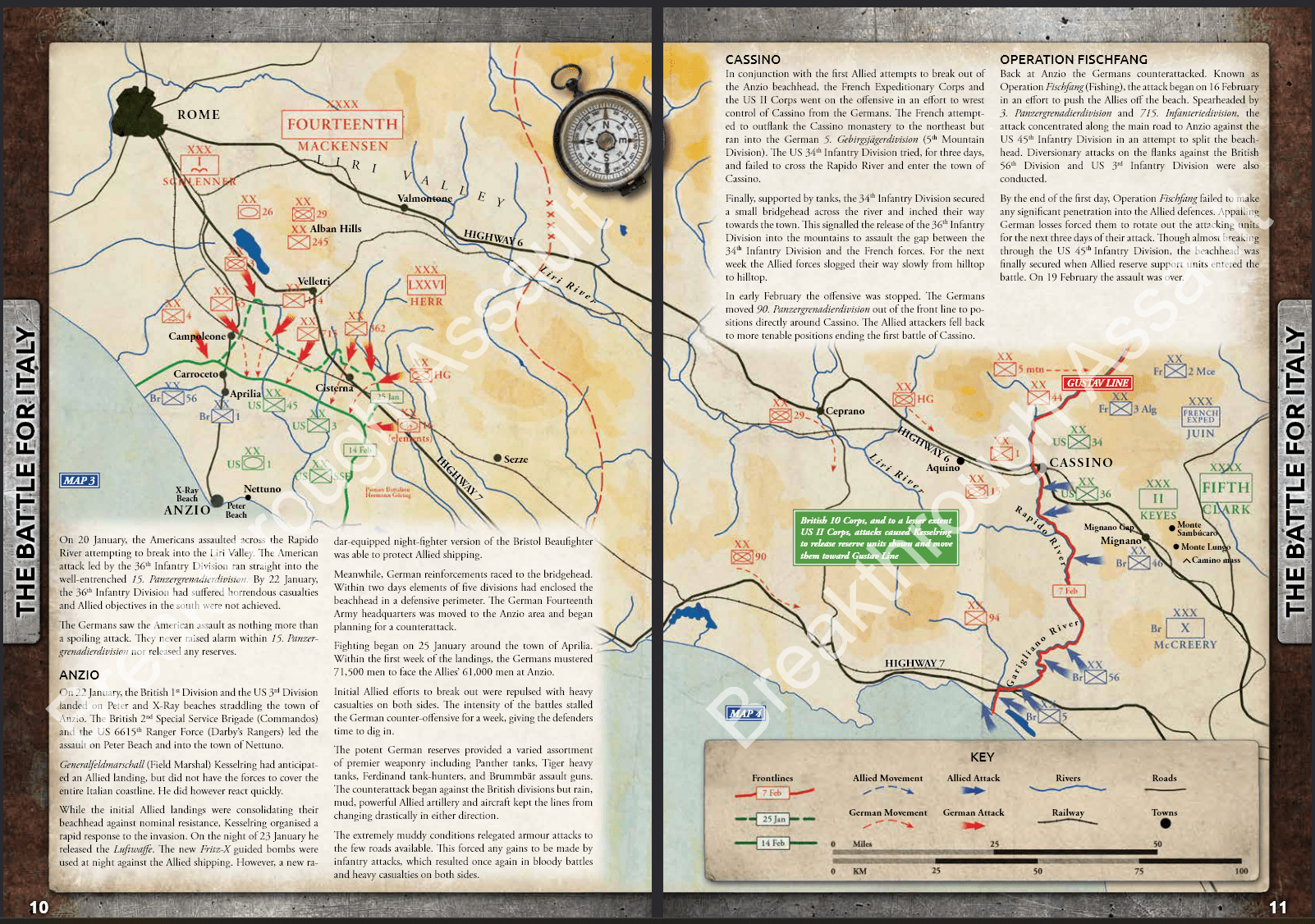
We’ve come a long way from the underwhelming first tranche of v4 books, baby!
Germany
Opening the batting for the book’s forces is, of course, the Germans. When Churchill considered Italy the “soft under-belly of Europe”, it was likely on the basis of the Italian Fascist regime folding like a pizza box. This was forgetting that Germany had been quick to bail out its junior partner all through the war and certainly had the skill to fight a brutal war of fighting withdrawals in the mountains and valleys of the Italian countryside.
The Germans bring seven armoured, one mechanised and four infantry formations to the fight:
- Italy Tiger Tank Company – now with a Ferdinand option in the second black box
- Italy Panther Tank Company – Flakpanzers 38(t) are back!
- Italy Panzer IV Tank Company – with Flammpanzers as an option in the third box
- Hermann Göring Panzer III & IV Mixed Tank Company
- Italy StuG Assault Gun Company – infantry box gives PzGr, Grenadier and Static Defender options
- Looted StuG Assault Gun Company
- Italy Elefant Tank-Hunter Company – with Tigers as an option in the second black box
- Italy Armoured Panzergrenadier Company – probably one of the least changed formations compared to other books
- Italy Panzergrenadier Company – Looted StuGs join Panzers as options in the third infantry box.
- Italy Grenadier Company – Again, little changed from Fortress Europe
- Static Defence Grenadier Company – a twist on the D-Day Beach Defenders. 3.7cm AT guns and no MG team options in the Grenadier platoons.
- Italy Fallschirmjäger – 7.5cm light guns and Scout platoons join the roster
The first impression may be “haven’t I seen some of those before?” Certainly only the Looted StuG are truly unique, but all the other formations have some differences to the ones in D-Day and Bagration and, importantly, it puts everything in one book. Plus there is a good selection of command cards that utilise these as building blocks for some of the major units of the campaign.
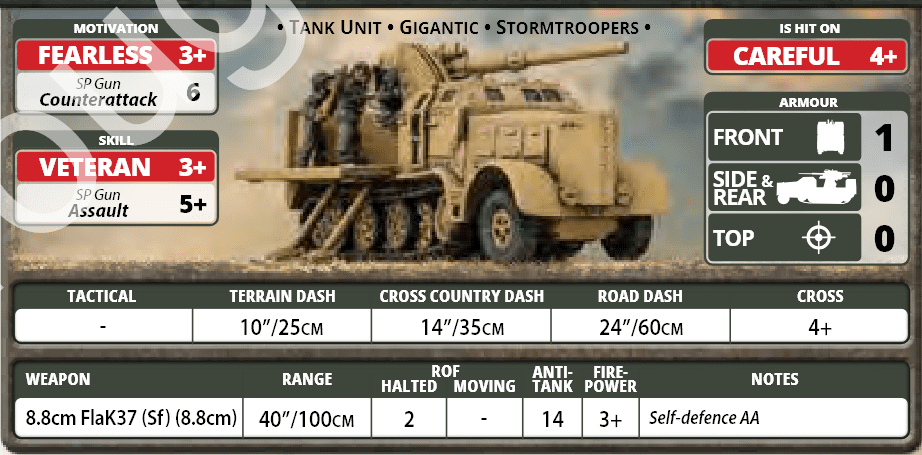
The Force Diagram similarly has little fully new. Old favourites such as Brummbar and Flammpanzers join Marders, 88’s and Panzerwerfers. Indeed there are a few things I was hoping to see; Fallschirmjäger 7.5cm and recoiless 10.5cm artillery for example, that are not in the book. But we do get the wonderfully odd self-propelled 88’s back!
Oddly, despite the mountain fighting, there is no option for a dismounted OP in this or any of the nation’s forces, save the CIL (though one of the British command cards mentions a dismounted OP!).
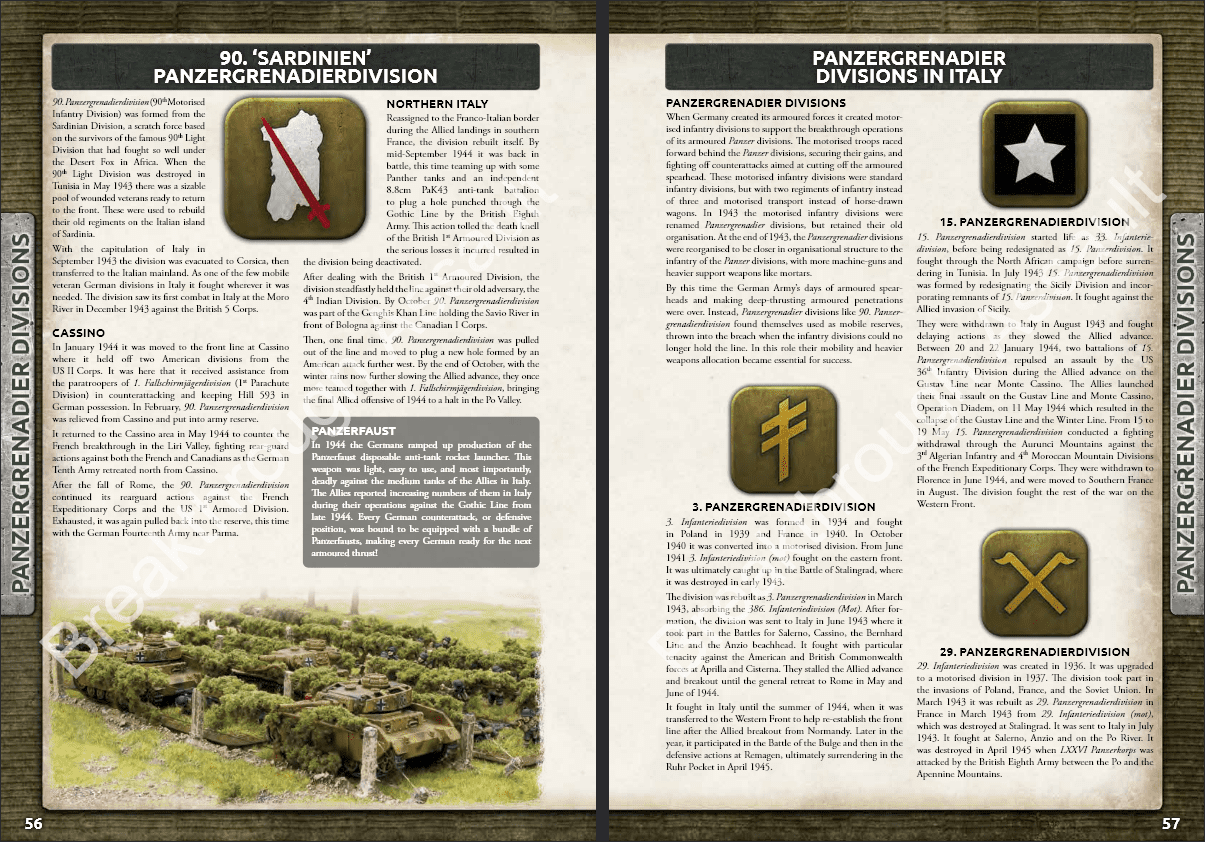
Out of the box, most formations are Confident, Veteran, Careful. the obvious exceptions here are the Fallschirmjäger (Fearless) and Static Defenders (Green and Aggressive). Every formation is proceeded with a page or two listing the historical units that best match the formation; 90th ‘Sardinien’ for the Panzer Grenadiers, for example, with other similar divisions covered (3rd, 16th and 29th Panzergrenadier to continue that example). Again, this is consistent with its counterpart of the previous edition and great to see.
Focusing on the “new” formation, the Looted StuG Assault Gun reflects the Germans “acquisition” of the Italian army and industry, incorporating Semoventes into new StuG units. These StuG units mirror the layout of a normal StuG battery; single tank HQ, two-three platoons of tanks and an infantry box. But where they differ is the contents.
Each tank box allows the option of either the StuG M42, the 75/18 Semovente we know from the Desert War and its later, longer barrelled and up-engineed 75/34 from Mid War Monsters. Also joining us from the MWM house is the other option; the M43. The M43 used a new, larger, heavily armoured (well, by Italian standards – its basically matching an M4 Sherman) chassis that could accommodate a larger gun; either a 105mm tank howitzer or a long 7.5cm, broadly similar to a StuG G.
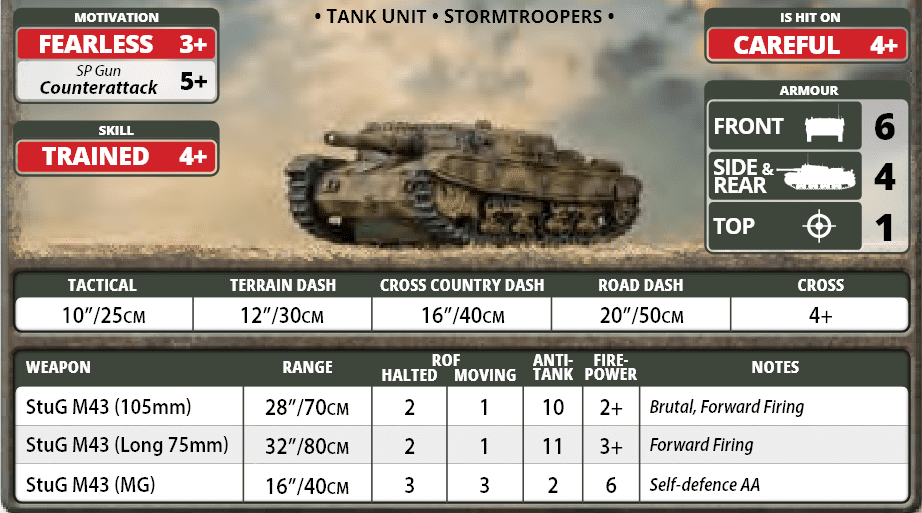
There is one bugbear here, the 105mm is RoF2 static! Somehow a tank more cramped than the StuH can outshoot it! I wish BF would up the RoF of the StuH to match its minor axis equivalents because the original Flat Panzer Howitzer just feels a little inferior to its copies!
The Looted Panzers are Fearless Trained Careful making them a more cost-effective alternative to the StuG; 3 M43 with long 7.5cm cost almost the same as 2 StuG G and can threaten Allied tanks just as well. I suspect we will be seeing a lot of the Italian flat panzers!
The Command Cards bolster the book nicely. Along with the normal pioneers, softskins and PaKfront we gain some uniquilly Italian additions. Pack Mules join Trucks to give the Gebirgsjäger a gun transport suitable for the mountains of Italy. Bogwards allow Tiger platoons to be upgraded to Radio Control units, directing the demolition vehicles to their target. Pantherturm upgrade a PaK40 platoon to Panther Turret defences!
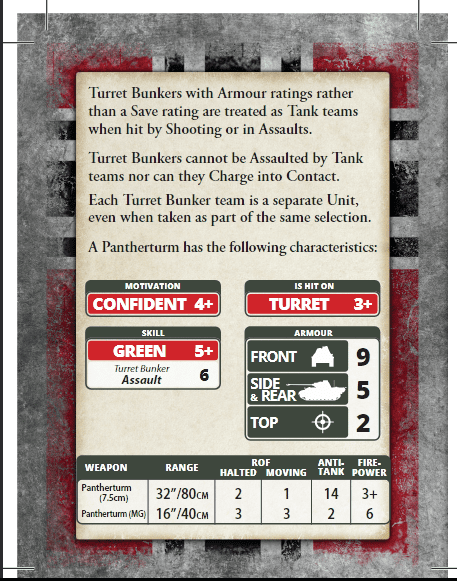
We also get a range of unit title cards too:
- “Reichgrenadier Company” reflects the battered 44th Hoch und Deutchmeister as it degrades Grenadiers to Green but reflects their veteran NCO corp with a 4+ Assault boon. I feel the points reduction is not nearly enough to make it worth while!
- “Turkoman” makes a Static Defence Company even cheaper by degrading them to Reluctant.
- “Green Devils” reflects the tenacious defence of Cassino by 1st FJ by giving the paratroops 2+ Last Stand
- “Gebirgsjäger” modifies a Grenadier Company by giving them the “Mountaineers” and access to unique artillery.
Is any of this likely to unseat Berlin as the go to tornie meta for Germans? Probably not. But that’s not the game I’m playing… For me, this is an excellent *thematical* book for the Germans.
Republica Sociale Italiana (RSI) Italians
The first of three Italian forces in the book. This part reflects the divisions raised by the RSI puppet state set up by the Germans in Salò (wasn’t there a film about this? Wait. Darren, don’t google that…). It’s a compact force with only three Formations:
- Infantry Company
- Parachutist Company
- Reconnaissance Company
The Infantry Company is rated at Confident, Trained, Aggressive and sports a variety of units with Italian equipment. The infantry platoons sport Breda MG and Carcano but can back this up with Panzerfausts and PzShreks and also have the “Stormtrooper” keyword. These are backed up by an MG platoon, up to two platoons of 8cm mortars, a 20mm Breda AA gun platoon, infantry guns with either German 7.5cm guns or Italian 65mm ones and an AT box that can use either captured British 6pdr and obsolete Italian 75/27 guns. It’s a well rounded formation.
The Parachutist Company is a very interesting formation.
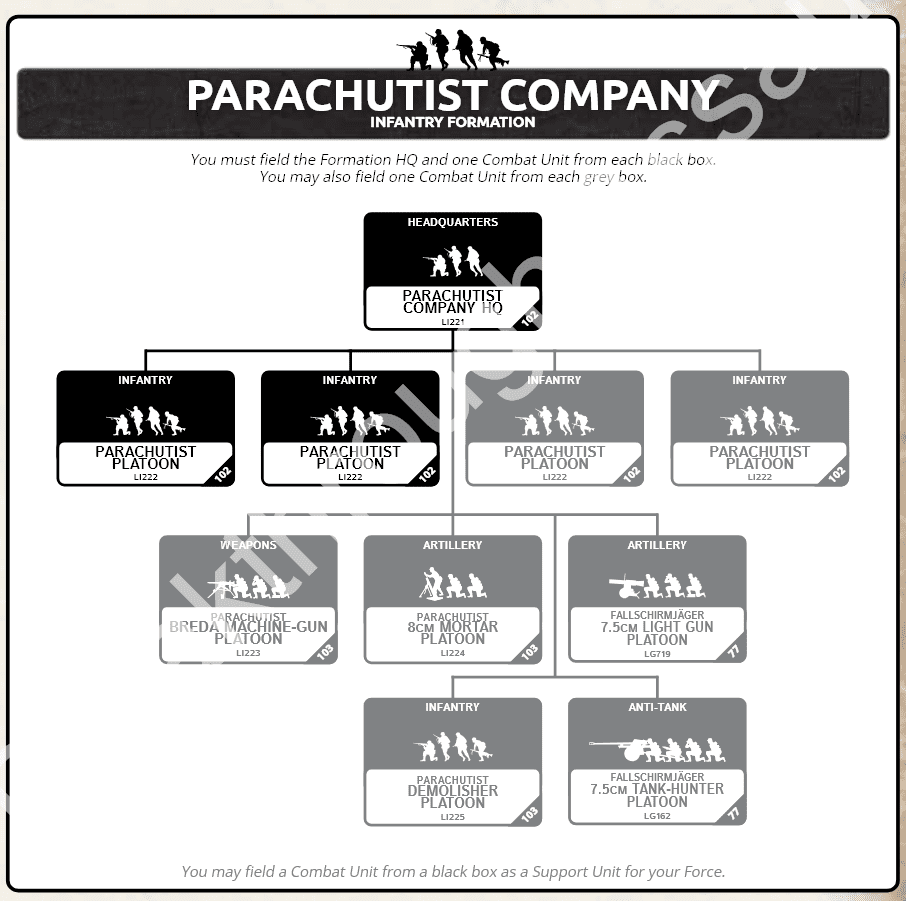
Combining Fearless Trained Careful Italians with FJ units like PaK-40 and Recoiless guns is a good start. However, throw in the fact that the Italian units have a 2+ follow me and a 3+ assault makes for a force that can cover ground quickly and do nasty things when it gets to its destination! Star for me is the Demolisher platoon, combining four Rifle MG PzF teams with three flame throwers and all the same soft stats. It makes for a very good unit to bring along to an urban fight!
The Reconnaissance Company is similar to the Infantry Company, but trades HMG and a platoon of mortars (and the remaining one can only take two tubes) for an extra infantry box and an AB41 armoured car platoon. The infantry gain Scout but have a 5+ last stand. It’s… fine. Probably the least interesting formation of the three.
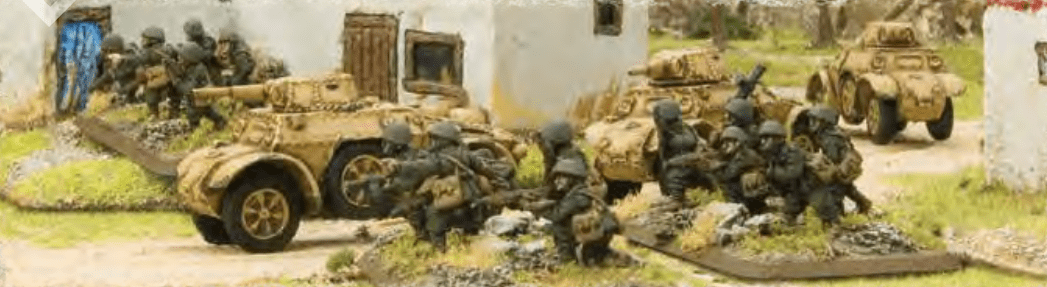
These formations are supported by a mix of Italian and German units. The only armour support comes from an AT box with Italian crewed Semovente 75/18 and German crewed StuG, Marder and Looted StuG options. These are joined by a box for static AT guns, AA (FJ 88s and 2cms plus Italian 2cm guns), Stukas and a pair of artillery boxes with options for Italian mountain guns and howitzers plus German artillery and observer support. Engineers and Recce round out the force.
The Command Cards again throw some interesting things into the mix. Motorcycles for the Recon Company give some mobility. Tank hunter platoons ape the ones seen in Berlin combining Rifle Panzerfausts with Panzershrek teams, ideal for hunting allied tanks in close terrain. There are title cards to upgrade the Infantry Company to “Alpini” (3+ counter attack and “Mountaineers”), “Grenadiers” (3+ Assault), San Marino “Marines” (Fearless), “Bersaglieri” (3+ “Follow Me” and terrain dash of 10″) and Decima Mas “Naval Infantry” (Fearless Green but with a 4+ “Last Stand” and 3+ Assault).
Of note is two Command Card formations. Parachute Swimmers Company represents Decima Mas’s frogmen and basically takes the FJ units out of the Parachutist Formation, then makes the Italians veteran.
Leoncello Armoured Group is what happens when an anti-Partisan force has to go peer-on-peer. You get a HQ consisting of an M14/41 with an optional M43(105), a platoon of up to four M14/41 with their blistering FA3 and AT6 but 6 MG shots each, a pair of M40 Heavy Tanks that really make the “heavy” do some, erm, heavy lifting, then a platoon of L35 tankettes! These are all Confident, Trained (5+ Tactics), Aggressive with the tankettes taking a further hit on counter attack and assualt because, well, its a tankette in late 44/45! Is this a good formation? No! Could it be fun to play againt the Allied militia force? Absolutely!
Overall, its an interesting axis force. The Infantry Company in an Italian force could be a lot of fun but the Parachutists in either an Italian force or a German one could be a good pick to turn up to a tournament too. Budget FJ!
On to the Allies!
USA
Much like the Germans, the US roster takes some familiar formations and force support and makes some tweaks to better reflect a US Army that has been fighting its way from the shores of North Africa to the mountains of Siciliy and now Italy.
The US get the following formations:
- Italy M4 Sherman Tank Company
- Italy M5 Stuart tank Company – basically the same as D-Day veteran Stuarts
- Italy M24 Chaffee Tank Company – basically the same as Bulge veteran Chaffee
- Italy Armoured Rifle Company – basically the same as D-Day veteran Armoured Rifles
- Italy Veteran Rifle Company – basically the same as D-Day veteran Rifles
- FSSF/Ranger Company
- Italy Parachute Rifle Company – D-Day Paras without the 57mm and Jeeps
The M4 Sherman gets some tweaks compared to D-Day. The formation gains the option of the Stuart-based M8 Scottt 75mm SPG in the artillery box as an option vs the typical 105mm M4. The 76mm Sherman platoon also goes to the second compulsory box, joining the second M4 Sherman platoon and a Stuart platoon as box options, ensuring there is always going to be one platoon of 75mm Sherman. The HQ and Sherman Tank Platoons both gain the option to upgrade any tank to an M4 Sherman 75 (late). Additionally, the Sherman platoon, but not the HQ, can upgrade two tanks to 76mm Shermans or Easy Eights.
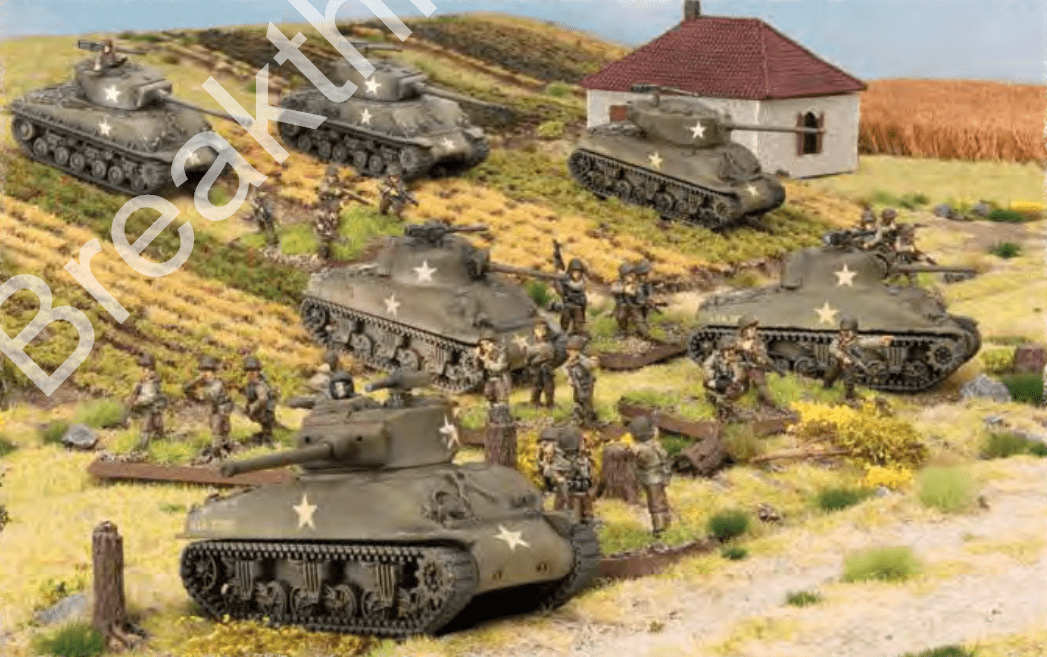
The FSSF/Ranger Company is quite a substantial glow up compared to its D-Day Ranger equivalent. The original 6615th Ranger Force had been fighting in the Med theatre since the beginning, landing in Operation Torch and fighting aggressively ever since, wounded and killed veterans being replaced by fresh, inexperienced troops. However, after landing in Anzio, the 6615th would be ordered to take Cisterna and would be almost wiped out.
First Special Service Force was a combined US/Canadian special force unit that would inherit the survivors of the 6615th and carve out their own legend. “The Worst is Yet to Come”, indeed!
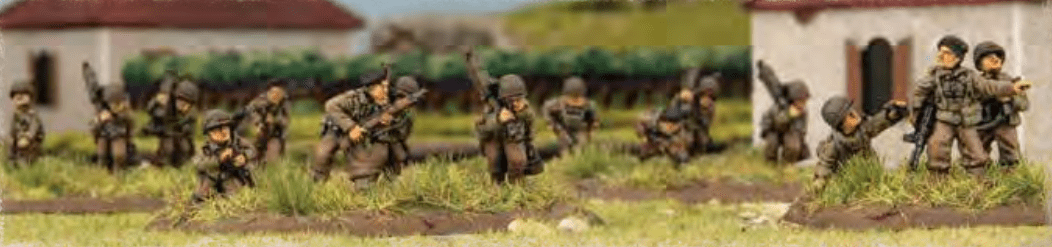
Compared to a D-Day Ranger formation, the FSSF/Ranger company has an extra in formation platoon and receives an additional artillery box to represent the artillery 376th (75mm pack howitzers) and 463rd (105mm Pack Howitzer) Parachute Field Artillery Batteries. Additionally the Mortar artillery box receives an additional option for Darby’s Ace-in-the-Hole; four M3 75mm Cannon halftracks. This provides much more bulk to the formation compared to the brittle D-Day version.
The Ranger platoons themselves are very similar to the D-Day version, differing only in that they gain the option of swapping two Garand stands for M1919 LMG teams.
Support follows much the same pattern as other D-Day Americans; similar boxes with mostly similar contents. The Recon Boxes Greyhounds are joined by the older White Scout Car based “Armoured Recon Patrol” and the AA box sees the M15/M16 platoon joined by static M1 40mm guns. Sadly, no M1 90mm guns!
As there is no Tank Destroyer formation, we instead get two AT boxes, each with Veteran M10, Trained M18 and Towed Tank Destroyer options.
All the normal artillery and Thunderbolt options appear too and its worth noting that the allies box has an additional note; as long as your force has a US formation from the force diagram you can TWO compulsory units from a British, French or CIL Italian from this book, not just one.
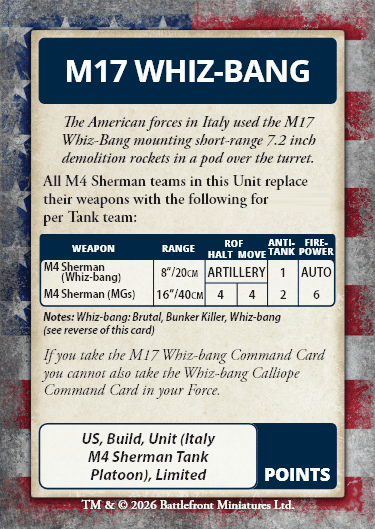
It’s the command cards that make the US section really sing. Notable cards include the 3rd Infantry’s “Assault Platoon” that allows a rifle platoon to become Pioneers, swapping a Garand for a flamethrower and being able to cross minefields safely and dig in on a 3+. The M17 Whiz-Bang adds a box of 7.2” rockets to the top of a Sherman’s turret for a powerful one-shot bombardment.
Finally, “Improvised Artillery” should be stapled to a Towed Tank Destroyer platoon, letting them fire as artillery so long as they don’t move from their starting position. M4 and M10 can also use the card.
Title cards mostly focus on the Rifle Companies. The Nisi, American-Japanese troops, “100th Infantry Battalion” converts the Veteran Rifles to Fearless with 2+ “Last Stand” and “Rally” as well as the “Go for Broke” rule. This allows a platoon that becomes pinned by defensive fire to take an immediate motivation check (so 3+) to conduct the Assault again, taking the defensive fire again. Good if you took five hits out of a six shot defensive fire! “442nd Regimental Combat Team” does the same for the standard Rifle Company, reflecting the fresher troops of the 442nd. 10th Mountain Division’s “Climb to Glory” modifies Veteran Rifles to “Mountaineers” with a 10” Terrain Dash whilst their “Daring Night Ascent” further lets them Night Attack. The Brazilian Expeditionary Force is also back with “The Cobra is Smokin’”. This downgrades the Rifles to “Green” but with 4+ Dig-In.
There are also a bunch of additional formations. Notable is the 91st Cavalry “Dismounted Cavalry Troop” that reflects the Cavalry units fighting on foot in the mountains. The Cavalry Troops start as a 10 Garand stand Confident Trained Careful platoon but can swap up to three rifles for Bazooka and swap all the Garands for LMG teams!
France
Much like the Italians, the French Expeditionary Corps get a compact, but interesting, Force to reflect their contribution to the campaign, fighting through Italy to get to their homeland. The French would be involved in some of the hardest fighting of the Battle for Cassino and breaking the Gustav line before joining the liberation of Southern France.
France gets two formations in the book:
- Compagnie De Tirailleurs
- Goum
Backing them up is French crewed Recce, M10 tank destroyers (and US 3” guns), M5 Stuart tanks, 105mm towed guns (and US M7 priests), 40mm AA guns and US OP and Thunderbolts. They can also, like the US, take up to two American, British or CIL compulsory units in support, reflecting the more mixed up nature of fighting in Italy.
The Companie De Tirailleurs mirrors a US Veteran Rifle Company in its lay out and unit composition with the only substantial difference being the lack of a 105mm Pack Howitzer option in the artillery box.
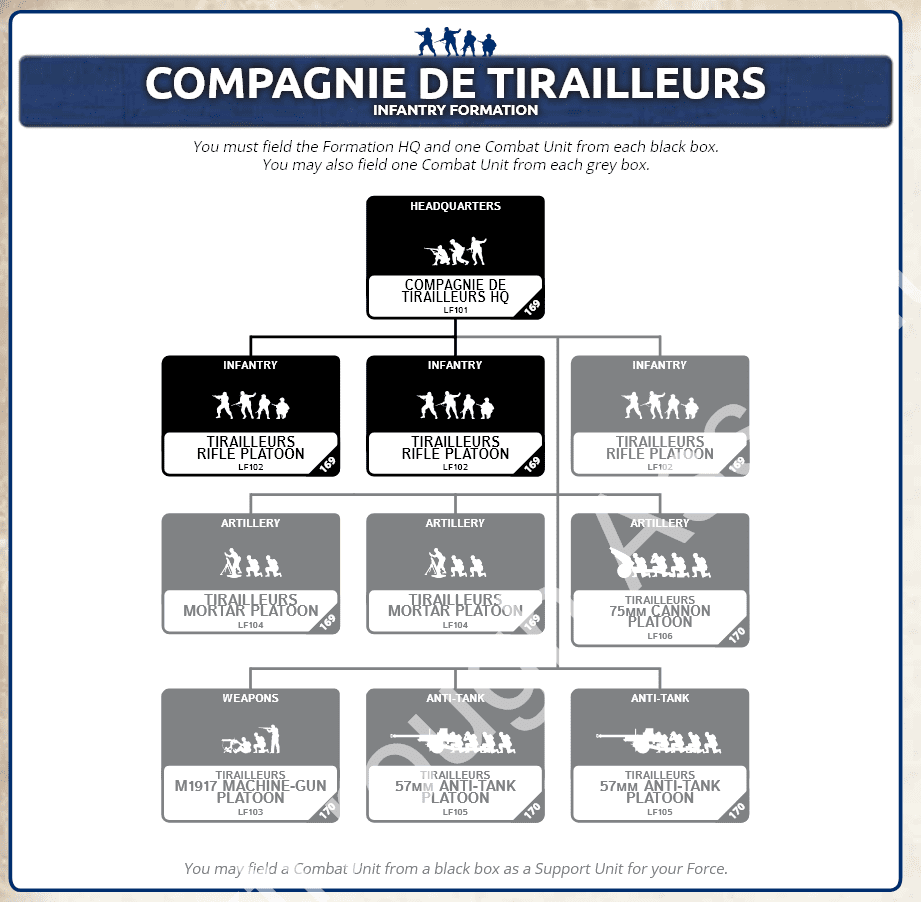
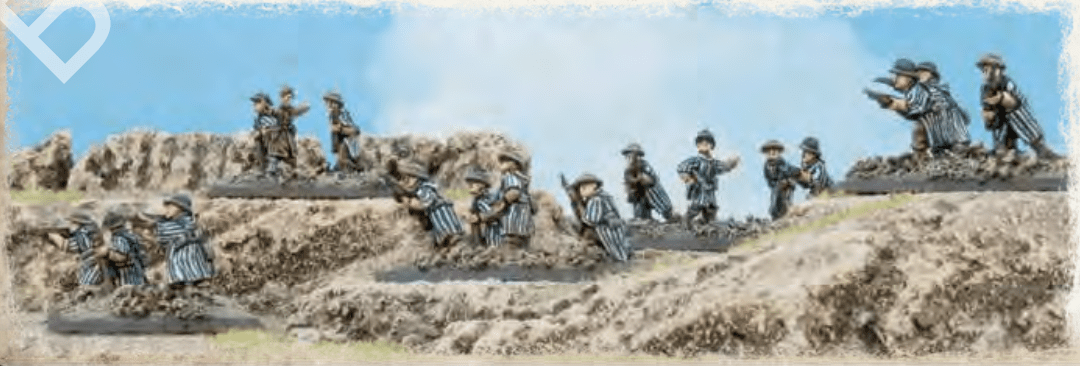
The real difference is in the troops. With a mix of French veterans and colonial troops, the units have an impressive Fearless, Trained (with 3+ Assault), Careful stat line, though that does make them a bit more expensive than their equivalent US Veteran rifles. This is a force that wants to get up close with the enemy, rather than just sit back and shoot!
The Goum are a much more straightforward formation. No AT Guns, pack howitzers or MG platoons; instead you get two to three Goumier rifle platoons, a mortar platoon and a scout platoon. The Goumier exchange Careful for Aggressive but gain “Mountaineers” and “Scout”. Their platoons lack Bazookas and can only have one attached MG, but you get a force that can make use of broken terrain to take it close to the enemy infantry and guns (and, sadly, civilian populations).
The support assets for the French tend towards Confident, Veteran, Careful, with the cavalry Recce platoons and M5 Tanks getting Fearless.
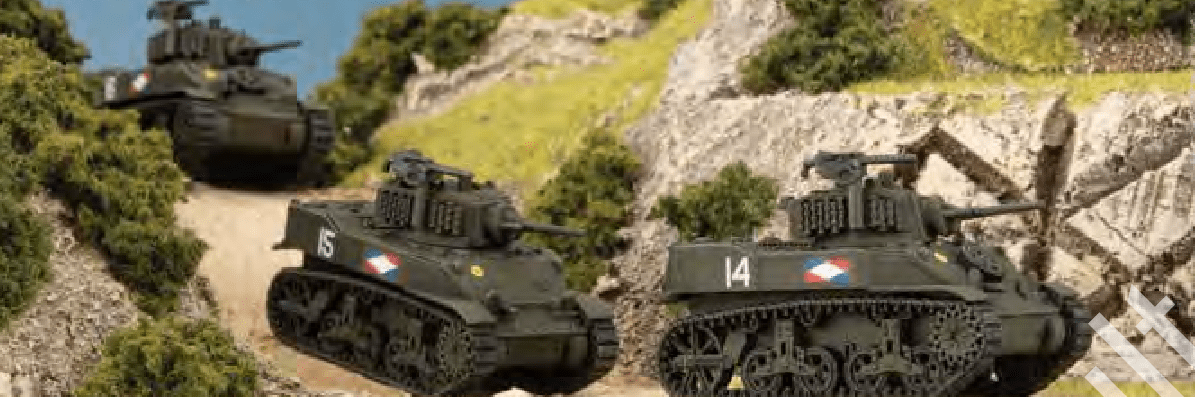
The French will likely want to have some US tank and air support to back up the M10s but can generally rely on their own support to do the job.
Looking towards the cards, we get three additional formations:
“Sapper Company” – two to three Sapper Platoons that mix rifles, HMG and bazooka and the Pioneer Keyword.
Escadron De Spahi – 2-6 Recon platoons, M8 Scotts and a Stuart platoon.
7e RÉGIMENT DE CHASSEURS D’AFRIQUE – A tank destroyer company with a Scout Car HQ and 2-3 M-10 platoons but no security sections.
There are no title cards to upgrade the existing units, though both formations receive Warriors that boost a particular platoons stats. The only real equipment beyond softskins and pack mules is the “Improvised Artillery” card to upgrade the M10 to fire as artillery so long as they don’t move from their starting spot. Could be handy with the Tank Destroyer Company?
The French are likely going to appeal to those who want an assault focused force as its infantry are very much set up for that. It doesn’t have many thrills beyond that but sometimes It’s nice to be focused on just stabbing things…
British
For being a major power in the campaign, the British have quite a compact force with only four formations (plus a reference to using the Parachute Company (for 2nd Independent Parachute Brigade who served in Italy until June 1944) and Commando Troop (for 2nd Special Service Brigade who were in Italy until the end from D-Day).
The British bring the following formation to the Boot:
- Italy Sherman Armoured Squadron
- Italy Churchill Armoured Squadron
- Italy Motor Company
- Italy Rifle Company
The Italian Sherman squadron is certainly an interesting twist on the normal LW Sherman Squadron. For a start, its HQ gets access to the M4(105) or Sherman 1B in UK parlance. This almost fills the role of a CS tank, focusing on delivering HE and smoke at range (though being better at tank killing than a 95mm CS!). I’m curious what model BF are going to suggest to use as there isn’t currently a Sherman I in the range. The “Sherman (Late)” will likely be used though the engine deck (for a Ford V8) is strictly wrong…
The Troops are equally different to the NW Europe standard. Don’t get me wrong, you can take a troop of 2-3 Sherman V and a Firefly, but each box also allows an alternative tank troop. Three of them (including the two black boxes) can alternatively be a Sherman (76mm) Troop, equipped with either a mix of Sherman 75 and 76 or entirely with 76mm Sherman IIA. Britain was receiving 76mm Sherman as lend lease as the US started switching most its production of the MkII and III to the up-gunned variant, but decided to standardise on the Sherman V/VC combo for the Armoured Divisions and likely didn’t want the logistic headaches that 76mm and 105mm bought so shipped both to Italy!
The fourth Troop can either be a standard Armoured Troop or a Firefly troop. With three Firefly tanks in a troop, these were strictly only used by the NZ 20th Regiment, they grouped their Firefly in to the Squadron and Regimental HQ to bolster the non-Firefly equipped troops. I’m surprised this wasn’t left as a command card as I suspect we’ll be seeing it in non-NZ forces…
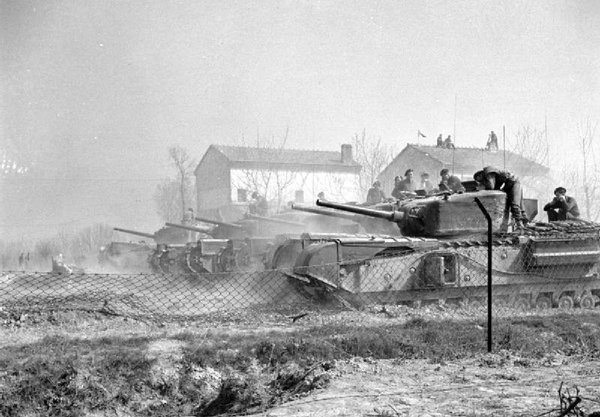
The Churchill Squadron is a refresh of the already Italian focused Fortress Europe version. The formation is unchanged with a mandatory Churchill troop, a choice of Sherman or Churchill tanks in the second black box and first grey box, then two more grey boxes add an optional Churchill Troop and Stuart Troop.
The differences lies in the Churchill HQ Troop and Armoured Troop, with the roster expanding from just 6pdr armed versions to include D-Day style pure 75mm and mixed 75mm/6pdr troop options and CS tanks in the HQ. The 75mm and CS tanks are the uparmoured Churchills so sport FA9/SA8 compared to the older 6pdr MkIII and MkIV with FA8/SA7. Sadly there is no option for a Churchill NA75, a workshop conversion to mount a Sherman’s 75 to a Churchill MkIII/IV and an early solution to the lack of a decent HE shell in Italy.
The two infantry formations are largely unchanged, save lacking a Wasp carrier option.
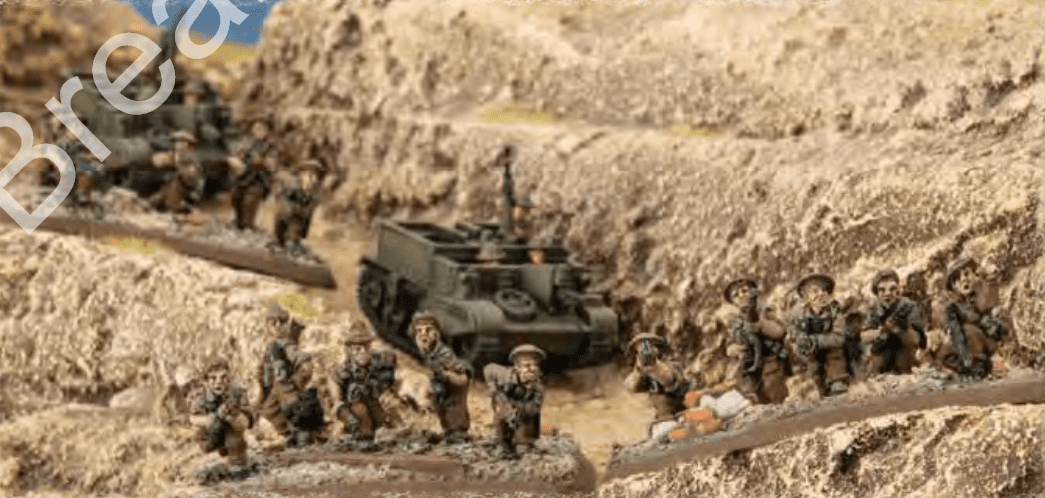
On first glance the Force Support looks very much like D-Day but there are some changes. For a start the AT boxes have been reduced to two with towed and SP guns (M10s and Archers) sharing the boxes. Oddly, only the Archer has AT15.
Crocodiles, a late arrival to Italy, are also only in one box.
AVRE and Artillery remain at 2 and 4 boxes respectively, with two of the artillery boxes gaining Sextons as well as Priests.
Air support switches from Typhoons to old favourites the Hurricane (now a Mk IV version with .303 MG and 60lb rockets giving us a budget Typhoon) and the Kittyhawk with its normal 0.50 MG and 500lb bombs. I think I still lean to the latter. The .50 is always a useful shredder of infantry and light armour.
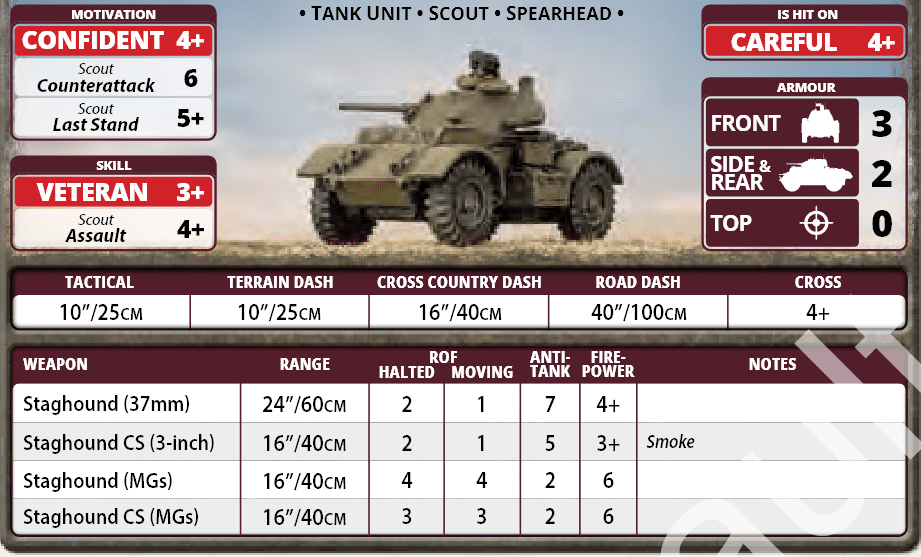
Recce has a big change with two new options joining Carriers and Daimlers; Staghounds and PPA patrols.
The Staghound had appeared in the cards for Berlin but here gets a proper book entry. Larger than a Greyhound or Daimler, it still sports a 37mm gun but more armour than the other two. Additionally, they were often modified to take old 3” tank howitzers to give a useful HE and smoke round to the troop lead.
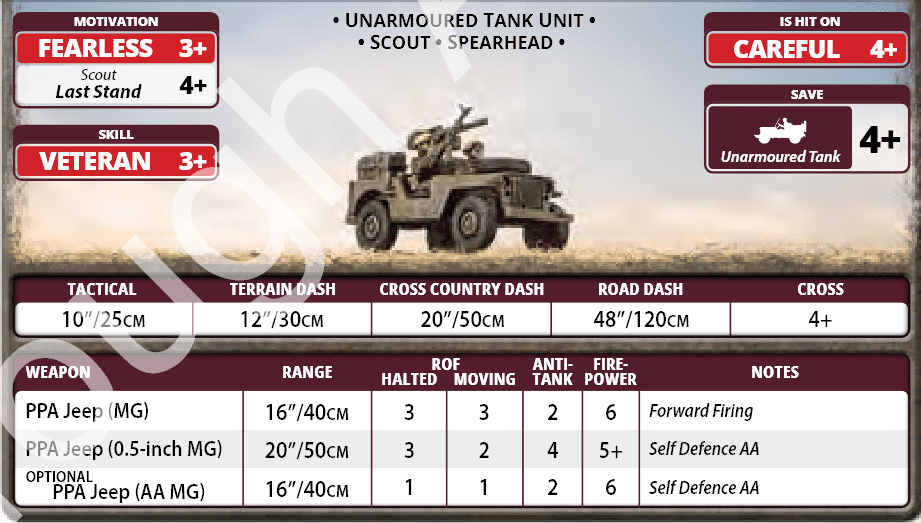
Popski’s Private Army was one of the many special forces that popped up in the desert war. Like the SAS and LRDG it made the transition to fighting in Europe, and they function much like the SAS jeeps in Berlin, albeit without the ability to be armoured and have no equivalent of the “Behind Enemy Lines” card; an odd omission given that was typically where the PPA were!
I’m going to do a deeper dive on British Command Cards, but there’s a lot here, allowing the full range of Commonwealth, plus Free Poland and Free Greek forces to be represented. There are also no less than 14 Warrior cards too!
Alongside these we also get cards for Canadian Armoured Trucks, Sherman Kangaroos (which I have some issues with how they are presented but I’ll cover that in the next article), Humber LRC and Autocar 75mms amongst others.
It’s almost rude to be picky at this point, but I was surprised that there was no Carrier .50 card or MMG Carrier card. Universal Carriers are frequently photographed with .50 on and the MMG Carriers were ubiquitous so, again, odd.
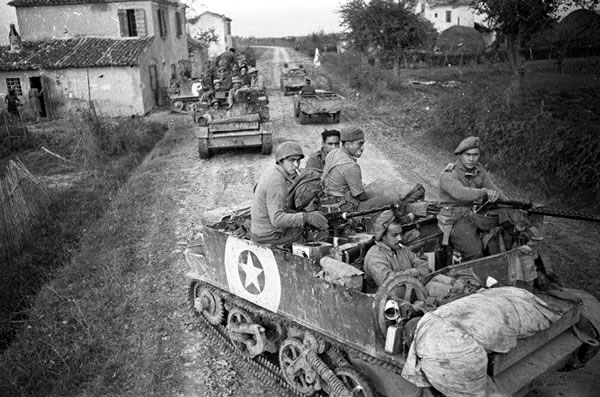
Whilst it would have been good to see the Paras and Commandos folded in the book proper, I can’t fault the British section for what it does cover. The Poles do a get a little hard done by (historically correct, at least in that regard, I guess) by not having their own recce and support but the book and cards generally work well for everything else.
Italian Corpo Italiano Di Liberazione
We’ve had the Italians fighting for the fascists, but what about the ones who were more than happy to kick Mussolini’s forces and his German allies out of their home? Step in the CIL.
Formed in April 1944 to place the Italians into some sort of command structure with a division sized structure and complying with the Armistice limitations on the total size of the Italian army. This new force was placed under the command of the British X corps, attacking along the Adriatic coast side of Italy to draw reserves away from Cassino.
The CIL get two formations:
A Rifle Company
A Parachutist Company
Both use a similar structure:
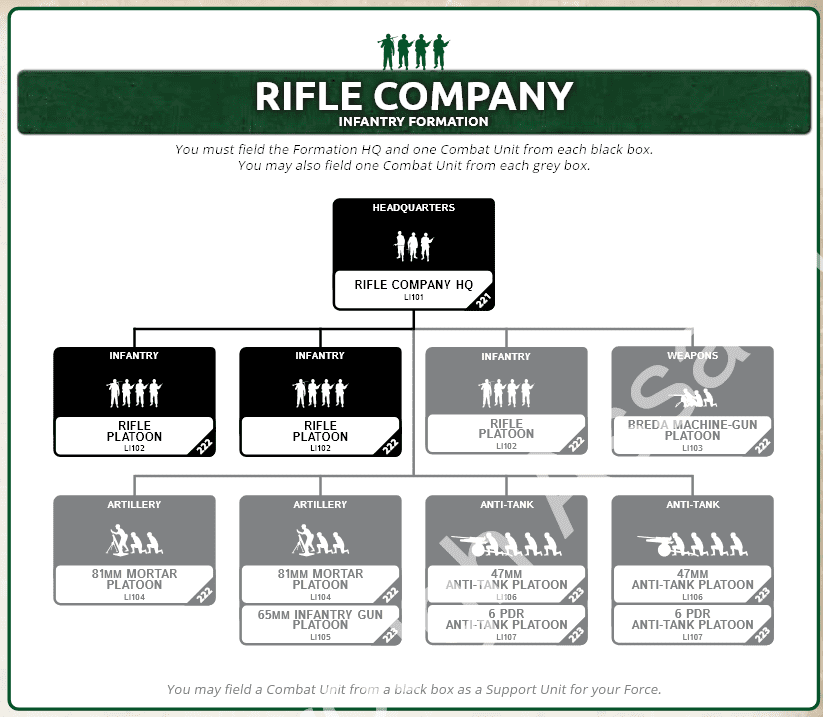
At this point in the war, Italy was still using mostly its own kit, though the appearance of the 6pdr reflects an ever-increasing rearming of the Italians by the British. The Infantry are still armed with Carcano and Breda MG and can add a Breda HMG, but lack any in-platoon anti-tank. The infantry have a perfectly adequate Confident Trained Careful stat line, but have a 3+ “Follow Me” and “Rally”.
The paratroops up the Confident to Fearless with a 2+ “Follow me” and also add “Deadly” for a 3+ assault. This makes them very useful up-close, so long as there isn’t a tank nearby.
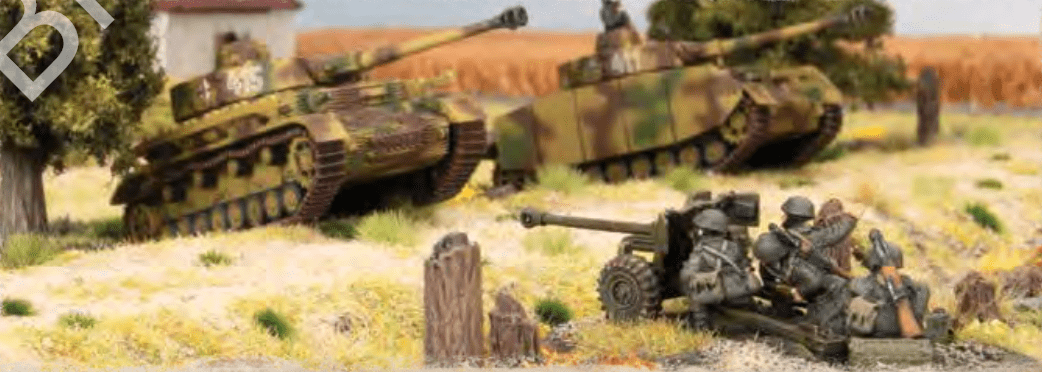
I quite like the support assets both formations get. The 47mm is showing its age but its just so mobile that that AT6 can get in some awkward places. Compliment a platoon of those with the ever-excellent 6pdr (rocking both APDS and HE rounds) and it goes some way to dealing with the lack of AT in the infantry platoons.
The 65mm is an interesting complement to the 81mm mortars. It lacks smoke but has better range and AT in the bombardment and a useful direct fire capability whilst still be relatively manoeuvrable.
In terms of support, the CIL can draw on a variety of artillery assets. It has two boxes of British 25pdr, joined by another two boxes that can be CIL 7.5cm mountain howitzers, 100mm howitzers, French 105mm, or British 25pdr. That provides a variety of ranged effects to put down range, all backed up by either a British mounted OP or a CIL dismounted observer.
Joining the artillery, there are two AT boxes to add British 6pdr or British towed 17pdr. There is also an AA box with Breda 20mm or British crewed 40mm options, an aircraft box for the RAF and a Recce box that adds on an Italian scout platoon or a Maiella Partisan Platoon. The Scouts are Fearless (with 2+ “Follow Me” and 4+ “Last Stand”), Veteran, Careful and have up to 7 SMG teams making for a useful Spearhead and then an assault unit thereafter.
The Partisans are Fearless (albeit “Last Stand” and “Counterattack” 5+), Green, Aggressive but have the “mountaineers” and “already here” keywords which mean they don’t care about cliffs and don’t count for reserves!
I’d move onto the Command Cards, but wait! There’s more!
There’s another two force diagrams for the CIL!
With manpower shortages biting in the allied forces, it was agreed to dissolve the existing CIL divisions and form up six “Combat Groups”. These loosely followed the Italian model of two infantry regiments backed up by an artillery regiment, but the infantry regiments were modelled after British infantry brigades and entirely equipped with British equipment. Of the six, four saw combat before the war ended, being parcelled out to British and US commands. Because of this we get two additional force diagrams; one for a Gruppi Di Combattimento under US command and one for one under British command.
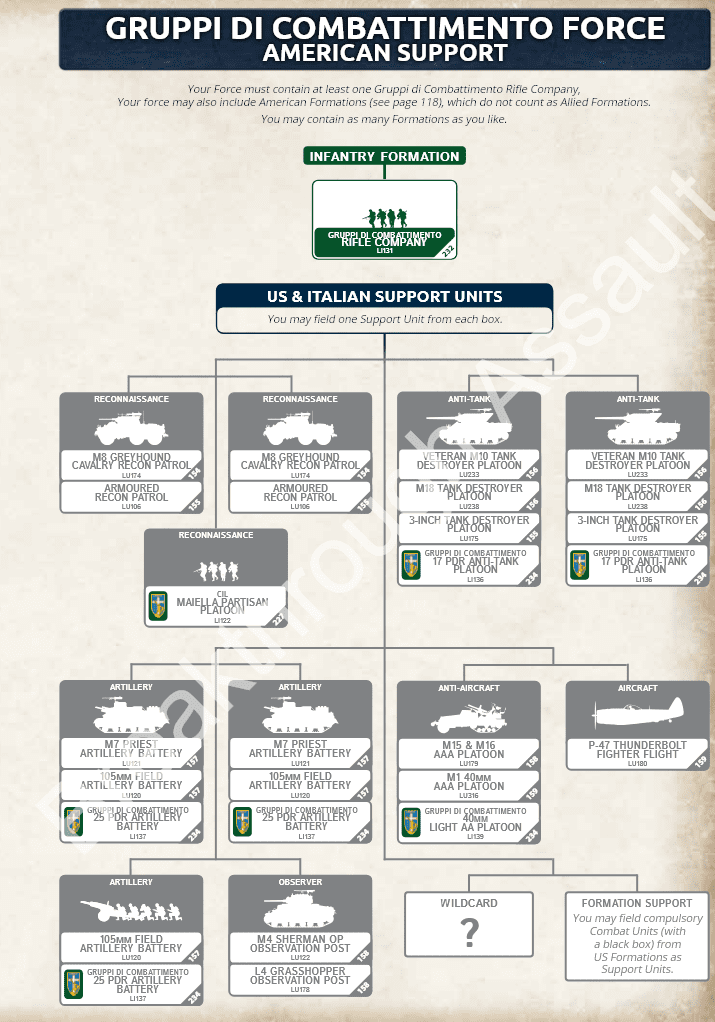
The GDC’s own support continues the theme of British equipment with Italian stats (Confident, Trained, Careful). This means their 25pdr are a couple of points cheaper than the Fearless Veteran British ones, whilst the Italian 17pdr are slightly more expensive as they get AT15 APDS rounds for theirs!
Looking to the command cards, the CIL Rifle can be upgraded to “Alpini” (gaining Fearless with 4+ “Last Stand” and “Mountaineers”) or “Motociclisti” (gaining motorbike movement). They can also field 105/28 and 149/13 artillery.
The GDI units upgrade their rifles to reflect the various different battalions in their Combat Groups such as “Mountaineers” (gaining “Mountaineers”), “Veterans” (gaining a Veteran rating), “Reluctant” (gaining a Reluctant rating but with a 4+ follow Me), “Fearless” (gain Fearless with a 2+ “Follow Me” but also become Green) and “Parachutists” (Fearless with 2+ “Follow Me” and Veteran). Some of those cards are cheaper than others, as you can guess! Mike made the observation that the “Parachutists” should have got the option to be entirely equipped with SMG as they were in Operation Herring and that seems fair observation.
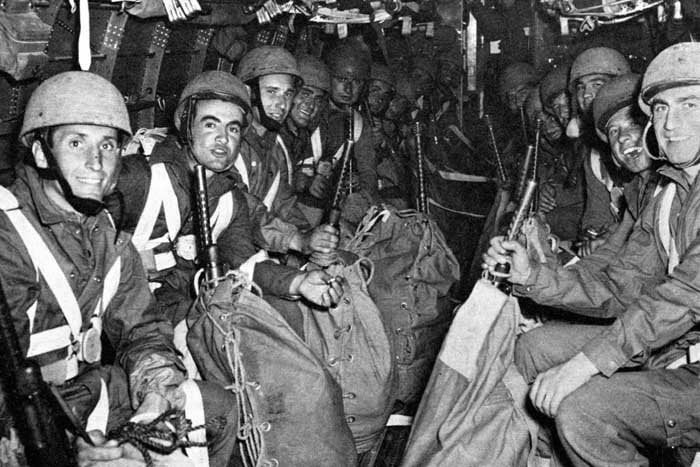
There’s also an additional formation, the Maiella Partisan Company which can be taken by British, American and CIL forces.
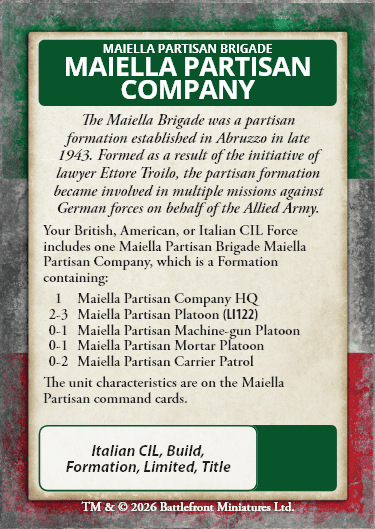
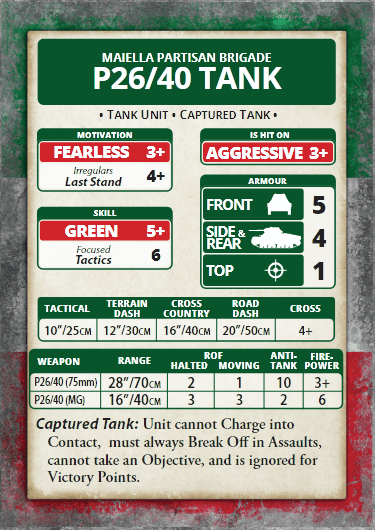
All those units have “Already here” and, with the exception of the Carriers, “Mountaineer” so you can potentially have a whole formation in addition to your normal “On table” units! There’s even a card that gives them a pair of P40!
The Lines
The book finishes off with a suggestion for a linked campaign to reflect the fierce fighting to break through the various defensive lines. This includes a new mission “Defensive Line” that works a lot like the D-Day landing missions with the defender having less points for their force but a budget for additional defences such as pillboxes and Panther turrets.
Conclusion
So, was the Italian book worth the wait?
Absolutely.
The history sections are well presented and the in-book formations reflect the core forces well, with the various card packs adding further colour to them. There are a few niggling omissions but nothing that detracts from the overall package.
It also works well as the foundation of a closed book event or tournament as everything you need (save the two British D-Day formations called up on their diagram) is in one book and the cards. Even better, its out well in time for the big “Operation Grapeshot” that we have planned for summer so stay tuned for coverage of that!

2 comments