Bagration – What’s new?
We have received a review copy of the new Bagration compilation and what a mighty tome it is. Coming in at 334 pages its certainly a shelf filler and contains Forces for not just 5 but 6 Nations as the Polish Home Army makes its return to the Eastern Front. This additon is in keeping with the general timeline of the original release which covered a period that was somewhat longer than the June to October 1944 of operation Bagration. The compilation effectively covers the fighting on the Eastern Front for the whole of 1944 through to the end of the war in Europe excluding the Soviet assault on Berlin itself.
Overall the book follows the tried and trusted Battlefront model of combining all the previous material published in the original Force books for German, Soviet, Romanian, Hungarian and Finnnish Forces as well as the scenarios and special game rules, in this case for River Assaults, into a single volume with some additional background text.. There are the regular basing and painting guides for the basic troops for each Force as well. There are not many obvious changes to existing Formation lists but due to the shear volume there may be one or two that have been snuk in I didn’t spot. Like previous compilations there are no points changes. Altogether we get 14 newly included Formations and some new Support options included in this book. That alone makes it worth getting if you already have the indivudual books. Overall there are some 40 additonal Units and Formations, added to the game. Reference cards for which come in the accompanying Bagration Reinforcements Deck.
Lets start with the new boys, the Poles. They only get 1 Formation and not surprisingly very limited Support options but you can do a bit of what if gaming if that floats your boat with adding in some Soviet allied forces, or to represent the Poles fighting with the Soviets. The Formation is a pretty much what you’d expect for representing the Warsaw uprising a predominanty infantry mix with either Polish Home Army (Fearless-Green-Aggressive) with 21 or more teams! Or Kedyw Partisan Rifle Platoons (Fealess-Trained- Aggressive) with just 9 Rifle teams both of these have extra equipment you can add, or swap teams for such as SMG’s, Flame thrower or Tank-hunter teams, etc. The Formation is bulked up with the usual mix of heavy weapons platoons and a a few small gun platoons. The Support options provide some captured German equipment but not a lot. Mark will be bring us a detailed look at these so that’s all for now from me.

So lets continue with the minor Axis/Allied Forces. These overall see little in the way of truely new things but everyone gets something.
The Hungarians see the Command Card Motorised Rifle Formation get added to the organisation Chart and included in the book so no more sorting through a pile of Command Cards to play with these troops. Alongside them comes a completely new Formation the Zyrini Tank-Hunter Battery meaning you can now field an entire Formation armed with the long 75mm gun but without the ability to bombard or a mix of platoon types. Overall the Zyrini 75mm is a slightly cheaper than the StuG equivalent (1 pt) unit but still not as useful as the Hetzer Tank Hunter with its larger platoon size option where you get 4 Hetzers for the price of 3 75mm Zyrinis. This Formation also lacks the option of adding in the Infantry platoon as a core Formation option. Coming in at just over 50 points for a full Formation it can easily be combined with a second Infantry Formation to make a stronger Force.

Romania follows a similar route with the Rifle Company now being included on the Force diagram and included in the book again moving from a pile of Command Cards to an easy to use list. This should make it easier to track is happening to the unit profiles when you apply additional Command Cards like Guards to these units.
Finally we have the Finnish and again here there is nothing particularly new the Light Infantry Company moves from the Command Card deck to being a listed Formation in the book again making things a bit simpler to keep track of.
Lets turn our attention to the main protagonists starting with the Soviets. Overall the Soviets gain 6 new Formations, 3 have been transferred and updated from Fortress Europe, representing units that fought throughout 1944 and ’45. 2 drop in from Berlin Soviets and the last is completely new. From Fortress Europe we get the Tank Battalions equipped with the earlier American Lend Lease M3 Lee, the British equipped Churchil Guards Heavy Tanks and the Soviet KV-1s Guards Heavy Tank Company as well the contextual background for the units they represent. The M3 Lees get updated to the Bagration period Formation unit options whilst the Heavy Tanks remain as they were. The third tank platoon in the Lee Formation is reserved for “Light” Tanks representing the earlier period Red Army organisation of two medium and one light tank Company in a Battalion

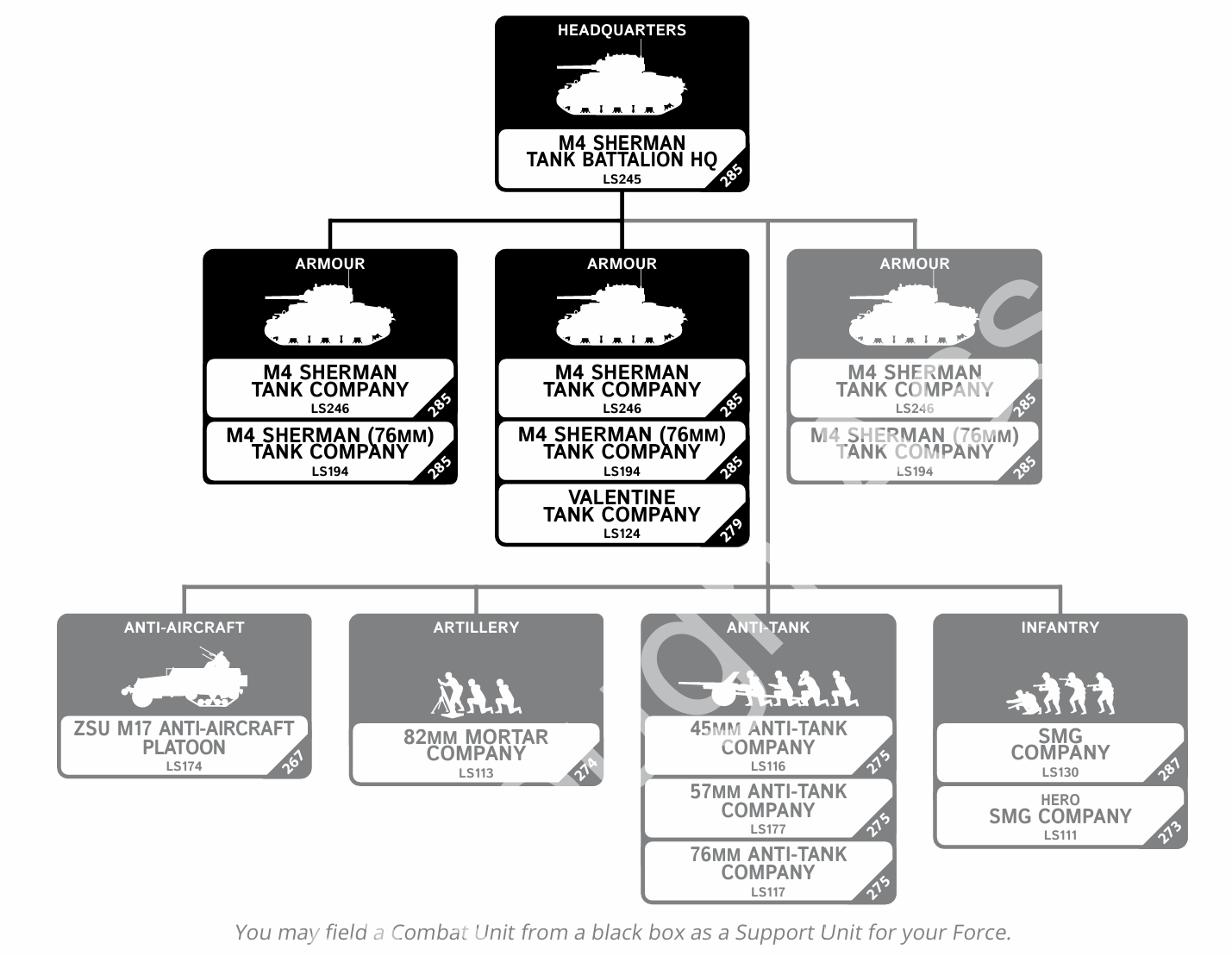
From Berlin we get the inclusion of the M4 Sherman and Hero M4 Sherman Formations both of which allow you to field a mix of 75mm and 76mm armed Sherman Platoons (even if that’s not strictly what happened in WW2) along with their accompanying support units. At roughly 0.5points per tank more than their T-34 equivalent these make for an appealing option, trading manouverability for extra front armour and a better remount thanks to having protected ammo.
If you want to field an armoured force then the Hero M4 Formation is a solid option. Two platoons of M4 76mm come in at a handy 40 points for your Reserves requirement unlike in the T-34/85 equivalent where its 3 platoons for Reserves. This makes the Hero M4 Battalion a highly flexible Formation choice, able to effectively perform when choosing any game stance for mission selection. Additionally the Reconnaisance Company has been updated to allow the inclusion of Hero M4 Shermans in its armoured platoon slot.
Finally we get the all new Matilda II Tank Formation along with accompanying background. These follow the standard Soviet Tank Company set up of HQ, 3 Tank Platoons, SMG armed infantry, AA halftracks, anti-tank guns and 81mm Mortars. The Matilda II platoons are restricted to 7 tanks and you can only field 2 of your 3 platoons equipped with the venerable Matilda II. Overall the Matilda II in Late War is an interesting option, with FA7 and SA6 as well as TA2 it can bully infantry and safely sit under most artillery templates to hold ground but wont get far in a tank engagement being armed with the now very outdated 2pdr gun with AT7 FP4+, mixing in a couple of CS Tanks may be useful for digging out infantry. A Tactical movement of just 8″ (20cm) is another limiting factor. These are going to compete with the other British Lend Lease equipped Light Tank platoons with Valentines or Soviet T-70 platoons in lists. At 12 points for 7 hulls they are pretty cheap so will certainly see some players choosing to field them, most likely as single Support platoon choices. It should be noted there is correctly no Guards option so they are further hampered by having the Red Army Green Skill rating but they will hang about and need proper AT assets to be used to deal with them, AT9 Stummels won’t cut it.

So lets talk Germans and here we get just 3 Formations but theres also some new Support platoon choices. First up are the Tiger II’s of 501 Heavy Panzer Company a beast of a formation equpped with mighty Tiger II’s but it isn’t cheap and is Agrressive and only Trained making them a little less points intensive but to be honest with FA 16 Aggressive is not an issue but the Trained may prove to be an achilles heal in assault, coupled with being Confident for counter assault motivation. They will hold ground well and I see them more as a Formation Support option.

Next we see more Command Card Formations move in to the book with the addition of the Ostfront SS Panzer Battle Group and Ostfront SS Panzergrenadier Battle Groups representing 3rd “Totenkopf” and 5th “Wiking” Formations these are super flexible battlegroups of battle hardend troops with all the bells an whistles being not only Fearless but Vetran and Careful making them very tough but slightly more limited in number than the regular Heer units. One interesting note here is that the SdKfz 10/4 Light AA unit is the only SS unit rated as Trained – possibly a copy paste error? Both Battlegroups follow the model introduced in the Bulge books. Both allow a myriad of ways to build a formation with only some heavy artillery being a neccessary choice from the Support Units in the Force diagram. This is where we get to the new Support platoons added to the German Force chart with a dedicated SS Support platoon section with just Panzer Scout, Wespe and Hummel platoons.

Well that’s a brief overview of what’s new so time to get planning for those battles across the Eastern Front. Martin

9 comments